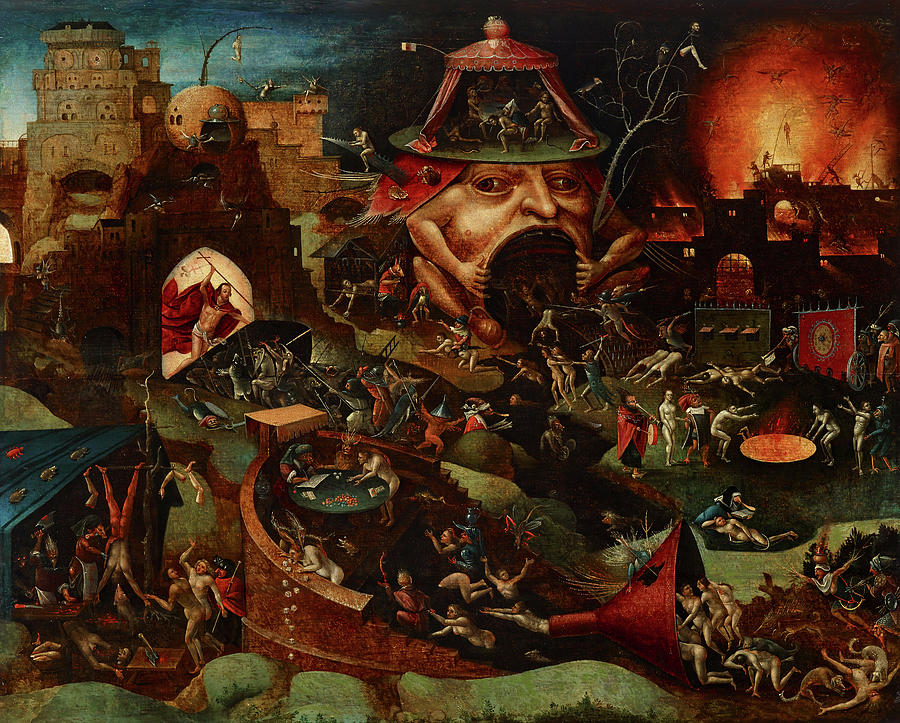
A few years ago, I wrote a post titled, "Is It Ever Right to Lie?" My thought on the subject has developed so much since that posting, and I'd like to return to the topic. This time, rather than asking if it is ever okay to lie, I thought I should instead contemplate the matter by asking: what actually happens when you lie? As we discuss the psychology of something as simple as lying, you and I are going to take a journey of abstraction together. As we do so, we may find that lying is not so simple after all, and may actually be one of the most powerful endeavors we can embark on: the enterprise of definition.
Let us start with the basics. What is a lie? I will not bore you or insult your intelligence with the dictionary's definition. Come with me to this other part of the mountain here and take a look. A lie is not merely a false statement. Let's take the harmless example of a magician performing a show. He tells you a narrative, weaving an illusion to show you what he wants you to see, and what he wants to hide. With a deft slight of hand, and crafty words, he convinces you of a certain truth, only to pull the rug from under you, to your wide-eyed amusement. The same concept in these tricks of entertainment carries to other (sometimes less amusing) scenarios. In the eyes of the deceived, a false image has been painted for you. The painter has taken advantage of your ignorance and has made you see what he wants you to see, and your trust has become your downfall. He has taken the threads of the universe and has woven a fictional reality, as the trickster Iago did for Othello, full-blooded flesh on the one side and hollow bones on the other. And you, in your naivete, have bought into the narrative and integrated it into the story of your life. And by doing so, you have laid your bed on that phantom cornerstone. This is why the deception is so significant and, when found out, disastrous. For every accepted truth is like a pillar of a house. Once established, you build around it, on top of it, across it. Your sense of the world is dependent upon it. Your livelihood weighs upon it, so woe to you if a pillar proves false.
The foundation holding you up crumbles beneath your feet. Is there anything, then, you can trust? The painting rips away to reveal skeletons in a closet. No painting in the world can touch your soul again. The fabric of reality tears at the seams and you find yourself staring into the gaping black hold of the void, paralyzed and frail. And if you don't keep yourself, the void may suck away at your soul until you are but a shadow of yourself and your hollow eyes see nothing but emptiness in the world, devoid of life and meaning. This is the wasteland the deceiver leaves in his wake, the lie blown off like chaff in the wind.
Of this monster of the world the small everyday tricks are but mere imitations. The innocent deceptions made in jest by the entertainer are washed-down versions of the real dragon, like the cute cartoon devils with pitchforks are of the true fallen angel. I proclaim no judgment on the white lies of a benevolent heart save this one: that all lies, though of varying intents, bear this same sin: the fabricating of reality. In this enterprise of definition, man plays God, just as the rebel of Heaven plays God to this day.
This coldness of the underworld is also left to the victim of betrayal. The man wounded by a faithless lover peels through every page of their history, questioning the reality of every smile, word, and kiss. His doubt grows like his shadow, putting everything he has known on trial in the courtroom of his mind until he ends up prosecuting even himself. The one with the knife in his back may question his reality until one day he decides that nothing therefore is real, save the black hole of despair. In Dante's Inferno, the interesting choice was made to condemn Judas the Betrayer to the deepest pit of Hell, next to Satan himself. It seems that the gravest sin of all, next to the pride that split the heavens, is that of plunging the knife in the back, that of sacrificing a brother's blood for one's gain, that of the kingslayer.
Then there are those who would rather believe the lie if given the choice. They would choose the fabrication and even try to weave one themselves, all to escape the thing that is much more terrible--the truth. For the truth hurts. It is a double-edged sword that cuts between bone and marrow. It rips open your deepest secret. The cold certainty of Truth weighs like a heavy hand on all you knew, or wanted to know. It is both precious and dangerous, so much so that few would dare look into her face lest they see that of the Gorgon. For Truth often wears a terrible face, paralyzing all who look upon her as they watch their world crumble around them. But would that mean that the hurt is not worth the revelation? Could we then weave a fiction out of mercy? To that I answer, "Should we then stop all doctors from giving bad news, the lawyer from presenting evidence, and the god-forsaken newspapers from printing (though I sometimes do wish the press would shut up)? Shall we stop all surgeries because they cut through flesh and sometimes leave men bereft of a body part?" What then shall we do with the truth, that blade that sits upon the surgeon's table?
Make no mistake, however: Truth has two faces; one hard and terrible, the other bright and benevolent. It has the heavy gavel of the father and the nurturing bosom of the mother. It can fill your world with light or strip away all mirth. Truth is an embalming oil, the mender of souls torn apart. She looks favorably on all her children, all who cross her name over their hearts, who raises the war banner with her emblem. But on her enemies she sneers. She haunts them and hunts them like a hound. They ward her off but she remains in their dreams, a horror that denies them even the bliss of solitude. She serves no man; she serves herself and only blesses or curses a man.
The effects of the lie doesn't affect only the deceived, however; they also destroy the deceiver. In the act of formulating a pseudo-foundation for his brother, he has also found himself on the same soil. He has drunk his own poison and twisted his own soul. He has made for himself a trap of fiction to which he must adhere, though he knows better. He finds himself at the mercy of his own devices from which he can't escape without truth-telling. And as the loom weaves back and forth, he has no choice but to continue his treacherous efforts. But the more he weaves and the bigger his creation grows, he may one day find that he has not the strength to hold the threads in place. The beams and cords begin to pull him apart, and he discovers to his horror that the monster he has nurtured has grown beyond his fortitude, reflected in Dr. Frankenstein's horror at the creature of his invention. Truth stands in wait for the deceiver, sword in hand at the executioner's block. The blade may tarry but is held at the ready for when the threads finally snap and the verdict is declared. The enterprise of definition has been found to be too great for the hands of men, and those who attempt it without Truth at their side return twisted and disfigured.
However one chooses to call upon the goddess of falsehood, I believe its manifestations in all its variety are bred of the same soil. But the devil is in the details, and I expect that should we try to address every possible instance in which the lie might be proved an exception we would be here for an ungodly amount of time. I will end with this: threads of reality have been entrusted to all mankind. Consider carefully what sort of fabric you choose to weave.