Pages

Tuesday, May 3, 2022

On Moral Humility

(Context: There is a kind of philosophy or personal belief that argues, in essence: "Who are we to say that something is right or wrong?" This philosophy goes by many names and manifests in various ways in many cultures. One of its labels is "moral humility", the idea that one who is humble is careful not to make absolute moral claims. And to be fair, there is some reasonable ground for such skepticism which I do not intend to diminish. However, taken to its more extreme conclusion, one finds a level of moral relativism that hurts more than it helps. It is this kind of "humility" that we consider here.)

    The moral humility of the relativist is admirable, but bland. This is where post-modernism and Christianity once again split on their definitions, and ultimately their realities. The moral humility of the relativist requires him to decline taking a side on any moral issue (until, of course, someone steals his silverware). But in his efforts to avoid taking a side, he fails to take a stand of any kind, save indifference. For the sake of objectivity, he finds himself losing the object of his own convictions. In short, his moral humility strips him of his own moral authority.

    The personality of Christianity stands in stark contrast. Compared to the modern man, Christ may be accused as the most arrogant, moralistic man in history. Truly, nothing is more conceited than claiming Godhood, and with it the right to define morality. By default, Christ took a moral side, something the post-modernist is careful not to do. But I would also argue that the figure of Christ, while taking a moral stand without hesitation, is actually also the perfect model for moral humility--and it comes down to our understanding of humility.

    A common understanding of humility is the awareness and acknowledgement that one may be wrong, and the willingness to learn. While not untrue, it is incomplete, for there is a difference between seeking growth and lacking conviction. True moral humility strives for the development of a moral framework and knows, when having encountered the truth, when to plant the flag. The flagbearer may not be called humble because he chooses neither side of a battlefield but because he gives himself to the established values of the flag he bears.

    But let's continue considering humility. The difference between humility and conceitedness is not merely that of open-mindedness versus close-mindedness. That is too narrow an understanding. The difference is this, that one seeks itself and the other seeks beyond itself. For the conceited mind, all roads travel inward into itself; for the humble mind, all roads lead out of itself. One seeks to be fed and is never filled; the other seeks to feed another and is never empty. This is how Christ can make the most self-promoting statements and still be the epitome of humility. At the same time as being glorified above all, He turns around and says, "I can do nothing except what I see my Father doing."

    Thus, the morality of the relativist turns dull in contrast to that of the Christian. The former is unable to make any moral claim, and no wonder, as only he can be the anchor of his own morality. And what claim can one make based on oneself? The latter, however, can make the boldest of claims, as he is not his own witness: his affirmation comes from beyond himself.

Friday, April 15, 2022

If Only...


They missed it.

Late into that dismal evening, oblivious to his dire state, they missed it.
Failing to comprehend the gravity of that night, the tears in his eyes, the pain on his face--they missed it.
Would they have slept if they knew?
Would they have slumbered if they had heard his prayers?
Would they have been surprised had they truly understood what he had said for years?
The Bridegroom was with them only for a little while. And they missed it.

What thoughts must have plagued them that second day?
What questions lingered in the dead of night?
If only...
If only...
If only they had traded the comfort behind their eyelids.
If only they had looked upon his face one last time.
Then, maybe, they wouldn't have missed it.

The hour has come, was what he said.
The hour has come. The words rang in their heads.
The hour has come, and is now past. All over in an instant.
They slumbered. And they missed it.

Oh Lord, let me not fail to see your coming
In those moments when the curtains part,
When your footprint is embedded in the sand,
Let me not overlook it.
When transforming power manifests in your church,
When daily miracles guide me from dawn to dusk,
When the hour of the Bridegroom has come as last,
Let me not missed it.

Friday, December 31, 2021

The Star and the Angelic Choir


    Many sermons preached during the Christmas season talk about the wonderful assortment of people who were brought to the Christ-child throughout the story. The humble Jewish shepherds, the rich, educated Magi, even Simeon and the prophetess Anna. But what is just as interesting are the various ways those different people were led to Jesus. Why did the shepherds get the choir of angels while the Magi got a star? Simeon was told by the Holy Spirit about the Christ-child, and we don't know how that happened, but it could well be very different from the other experiences in the story. The methods of revelation were as diverse as the characters to whom they were given. Why? We can't know for sure, but here's a thought.

    As each of us journey to know Jesus intimately as our Savior and Lord, and to realize the message of the Gospel in our lives, we sooner or later come to understand that each child has a unique relationship with the Father. Just as giftings, needs, and callings differ, so do each of our paths to finding Jesus. Simon Peter's journey to knowing Jesus was different from Mary's and Martha's, and Paul's was vastly different from Zachaeus'. Similarly, mine is different from my parents' and my friends'. Some are given visions and prophecies, others are provided unusual spiritual advisors, and still others are blessed with minds that are poured into study. But what we all have are the Holy Spirit's guidance and a path towards knowing Christ. And that is what we see in the Christmas story.

    Wouldn't it be wonderful if every one of us could experience the vision of angels? I'm sure the Magi would have loved it as well, and it surely would have enabled them to locate Jesus more easily. But that was not granted to them. Instead, they were given something that was probably a little less extravagant but that fitted their unique set of abilities and knowledge. There is considerable debate about who these eastern men were, the subjects in which they were educated, the very nature of the star (if it even was a star), and how they could possibly know what it meant. Those debates are beyond the scope of our discussion, but whatever the case may be, the Magi seemed to be the only ones who deciphered the message in the heavens. Could it be due to their possible connection to Jewish literature through Daniel? Or maybe their connection to the pagan prophet Balaam and his prophecies about Israel? Maybe it was their knowledge of astrology that helped crack the code, or maybe it was something else entirely. But the point remains that the message of the star of Bethlehem was perfect and sufficient for a certain kind of people.

    This is not to say that the method of revelation is any indication of a person's sophistication or social status. The star is not reserved for learned folks nor the angels only for the uneducated. They are just different, but perfectly fitted for their respective audience.

    In the same way, while some of us may want to have visions comparable to the Revelation, God may grant us only a star to guide our pursuit of Him. And that's okay. That's good. It shows that He knows each of us uniquely.

    The question now is: what do we do with what has been given to us? For the shepherds, it was: will you do what the angel said and spread the news? For the Magi, it was: will you follow the star? For Paul on the road to Damascus, it was: will you follow Jesus who appeared to you? For C. S. Lewis, it was: will you go where the truth leads, even if you go reluctantly?

    To each God grants as He wills, and with it comes a corresponding call to action. What will your answer be?

Friday, July 9, 2021

What To Do With Ravi? What To Do With Us?


      This writing comes late, for several reasons. For one, I felt the need to wait until much of the noise had passed and the aftermath settled before writing, as I wanted time to reflect, understand, and make sure what I end up saying is actually meaningful. For another, I wonder if I should say anything at all on this matter. But I figured, considering the fact that I wrote a tribute to Ravi on the day of his death, I should address it somehow. But what I am about to say will probably not be what you are expecting to hear.

     I don't know if Ravi is guilty or innocent. Unlike almost everyone else, I actually cannot say if I believe one way or the other on this matter (not whether sexual harassment is wrong but whether it actually happened in Ravi's case). Why? I just don't know enough. And I refuse to uphold a verdict with the very little information I have--that we have.

     You might be thinking, "But we have evidence! We actually have an investigation carried out by a professional firm (read the report HERE)! We have witnesses, and all sorts of suspicious activity to point to! Isn't that enough?" Well, it is, if the integrity of each of those factors are indisputable. However, they might not be. In fact, Ravi's son, Nathan Zacharias, has been presenting counter-arguments addressing the questionable history of Miller & Martin (the investigation firm), biased sample pool of witnesses, manipulated "evidence," and more. I won't talk about the details here, but here is a link to Nathan's blog, "Defending Ravi," if you are interested in reading it. But if you do, please read all of it, because this is a son's attempt to defend his father while dealing with his loss, the shock of the scandal, and the evaporating support of those who once called them friends. Read all of it, and you are likely to learn something you didn't know before.

     Now, does this mean we should believe Nathan Zacharias? Not necessarily. But does it mean we should be more careful with how we approach the allegations we have been presented with? I think so. One critical thing we need to deal with is the fact that Nathan's position as son of Ravi Zacharias means he is either one of the most biased persons involved or one of the most credible. In other words, does Nathan's position as Ravi's son invalidate his testimony? To this question I have no answer, as with many other questions. There is so much we do not know, and the most important answers are inaccessible to me, a mere spectator, just like to the rest of us who are not privy to actual events. Context matters, and that is often the one thing that gets lost in transmission (whether intentionally or not). Nonetheless, I want to give the proper respect due to the Zacharias family, who deserves continued support from the body of Christ.

     But what is more important is how many Christians have been responding (or should I say reacting) to this matter, in whom I am bitterly disappointed.

     Even if Ravi was guilty as charged, the self-righteous cancellation of his name and the accompanying mistreatment of his family are inexcusable. And this is not just by social-media Christians, but by RZIM itself, the organization whose successes were due to the very man and family they now seek to erase. Modern Christendom's desperation to be politically correct and socially acceptable compelled many to jump on the bandwagon and assume the roles of judge, jury, and executioner, cancelling a man who is no longer able to defend himself. They have condemned him to hell, suggested that he never actually knew the Lord, and renounced his friendship. And when the furious rant dies down, they seek to blot out his name, his work, and his memory. And are they justified? In the name of truth, they choose to discredit any truth that he ever uttered. In reducing his identity to his faults, they also discredit the very gospel they claim to live by. They threw the first stones with Bibles in their pockets.

     Additionally, our focus on his failures very conveniently excuses us from pondering our own twistedness.

     Even so, I must say that I understand, and perhaps even sympathize, with the general sentiment that overcame Christendom like a tidal wave. If Ravi was guilty, such repercussions would even be expected. As is in the nature of betrayal, the hurting party suffers disillusionment as their fabricated narrative breaks down. However, if they are not careful, this can easily lead to bitterness and resentment; not taken care of, this will give birth to hate, until one day they find a desire in their hearts to watch the world burn. And even now, observing the reactions spiraling around us for the past few months, from both believers and unbelievers alike, there is a renewed hate that wishes to see institutional Christianity rise up in flames.

     So on the one hand, I cannot tolerate the self-righteousness and lack of grace with which many in the Church have handled this, while on the other, I understand the hurt and anger that others have experienced (regardless of the truthfulness of the allegations), and I want to push us towards healing and maturity as we struggle with the failures of our spiritual leaders.

     Whatever the truth is, we cannot deny the gaping wound in our hurting Church, a wound that has been there for far too long. If we do not learn to respond to it properly and heal from it, we would destroy ourselves every time the monster rears its ugly head.

     The last thing I want to address is the fact that Ravi's sins (whatever they are and are not) do not change the truths he had preached for over four decades. If we are unable to glean what is good from an imperfect person, maybe that is because we are too spiritually and psychologically immature to do so. I do not deny the positive impact of Ravi's ministry on multitudes of people, nor its genuineness; neither do I deny that God used him mightily for His kingdom.

     The truth and beauty of the Kingdom is breaking out into this world, though often tainted by its bearers. If salvation could come through the bloody hands of Roman soldiers and the tyranny of countless empires, surely the gracious work of God could come through tainted vessels such as you, I, and Mr. Zacharias.

Saturday, June 19, 2021

The Virtues I Do Not Have

     Some call me strong, gracious, resilient. Others say I have faith. I assure you that none of that is true. The more I observe myself as the days, months, and years roll by, the more I'm certain of this. They say the trials of life make you stronger; if that's true, I'd say I've been fairly privileged. And my privilege is my weakness. I read of the Christians in soul-crushing trials, of the likes of Bonhoeffer in Hell on earth. I see their grace, their conviction, their faith in the face of the unspeakable, and I know I do not have such in me. I have not the fortitude. Instead, I, at the first sign of trouble, am more than ready to shake the proverbial fist at the sky. Any other impression of me is merely that--an impression. A façade. So don't call me strong, or gracious, or faithful. I doubt any of the men and women of old would attribute such virtues to me.

     You might think that I'm in a pit of melodramatic pessimism. Perhaps I am.

     They say that God grants appropriate strength to whom He wills. Then perhaps I am unfit for such a grace.

     They say that I'm not the only one, that everyone struggles that same way. Then maybe we all need a better model for true virtuous spirit.

     They say, "A sapling cannot compare itself to an old oak." Neither can unrefined silver be compared to the refined. I must call myself for what I am. Then maybe God would have the grace to pass me through the furnace that is heated seven times over.

Friday, April 2, 2021

Golgotha

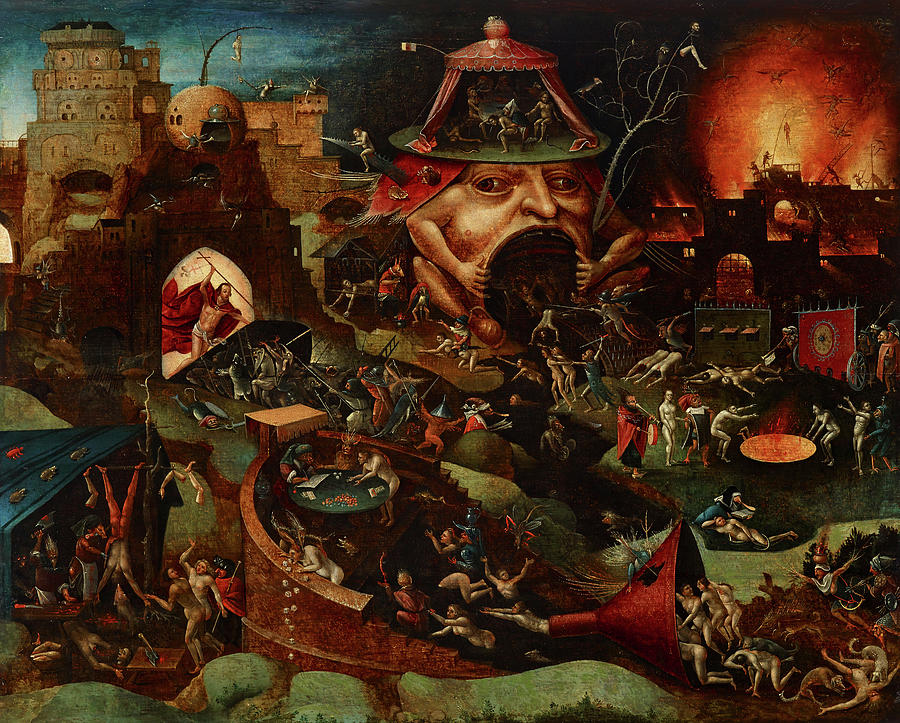
Amazing grace and extravagant favor That Golgotha would be graced by His presence And sprinkled with His blood. Death’s defeat was not merely its elimination But its beautification.

"Christ in Limbo" by Hieronymus Bosch


It was not mere human execution that took place on that hill, but a demonic onslaught. Men may have pierced His flesh, but Hell enveloped His spirit. Separated from the Presence and offered to Death, such is the wrath of God. What glee and cries of delight, the ugliest sound Heaven had ever heard, with which bloody chains assaulted Him. Screams of victory erupted from the throat of Hell as the Son was dragged into its bowels; the Father and Dove looked on as one of their own disappeared into the darkness.

But the darkness was too stupid to see the end, for the darkness blinded even itself. With the trap with which it ensnared mankind for millennia it ensnared itself. Never could it anticipate that the divine bloodstains in its halls would seal its demise. It did not realize that holding Him within its caverns made it possible for even those in Hades to say that the Christ was Emmanuel for them as well. It thought God was offering a sacrifice to Hell, when it was Hell that was unknowingly participating in a sacrifice to God. It lusted for His blood, forgetting the ancient warning that life is in the blood. It did not foresee its gates would be kicked open by the Dove, leaving a holy footprint to this day. It did not expect a mass exodus out of Hell, led by the Lamb who was slain.

And the Father watched as His Son, forever scarred, emerge into the light of the morning sun.

Saturday, August 22, 2020

The Two Greatest Failures of Every Generation


     Let us consider the people of Nineveh. Roughly around 760 B.C., the prophet Jonah confronted the wickedness of the city, resulting in a religious awakening and a swing toward monotheism. Thus, the people were spared from judgment.

    Fast forward slightly over a hundred years later to the days of Nahum. Wickedness prevailed in the city once again. Most of the people who were old enough to remember the revival of Jonah were gone, and Nahum arrived to proclaim a similar but more elaborate message. This time, they were not spared. Shortly thereafter, in 612 B.C., Nineveh sat in ruins.

    It took the Assyrian city five generations; for early Israel, not so much. Flip over the Book of Judges and we find the infamous cycle of rebellion, judgment, repentance, deliverance. Starting with the man Othniel, after he delivered Israel, "the land had rest for 40 years" (Judges 3:11). Then wickedness reigned again, and then came the Moabite oppression. Ehud rose up to deliver the people as the second judge, and there was peace for 80 years. Then came Deborah, whose work ushered in another 40 years of freedom before the cycle started again. Then came Gideon, after whom 45 years of peace ensued, before Israel turned again. Are you seeing the pattern? It took Israel an average of 1-2 generations for the spiritual climate to dry out. May I suggest that the primary reason for these frequent fallouts may be the lack of transmission of the knowledge and fear of God from one generation to the next? How would I guess this? It's the crazy possibility that members of the generation that went through one season of cultural wickedness lived to see the next in 40 years--and probably did nothing about it.

    Thus these I believe are the two greatest failures of every generation, which I still see to this day:

        1. The failure to impart healthy values to the generation after;
        2. The failure to receive and learn important values from the generation before.

    On one side, it is irresponsible not to pass on the wisdom, customs, and beliefs that sustained you in life. On the other side, it is arrogant to think that you can figure out this thing called life without the guidance of the past, let alone do it better than they had.

    That being said, it is at this point where I must unpack the layers of what we are talking about. At the same time as I am calling to retain the teachings of the past, I am also calling to renew them. We must be both adamant traditionalists and ardent progressives; I don't mean progressive in the postmodern sense (assuming it makes any sense at all), but truly progressive in seeking the renewing of the world. There is a reason why we human cultures propagate endlessly into new generations; so that we don't grow so old that we die of chronic stiffness. It is the job of the young people to birth our long-held value systems into new life, and I say we let them have at it. The problem is that these youngsters, more often than not, don't so much evolve our value system as much as kill it. They kill off more than they have to replace it with.

    That's not to say there ought not to be any killing involved, however. Every time something evolves, something needs to die; in order for the rocket to enter orbit, the thrusters need to fall off. You can trust the next generation to be merciless in their critique, but that is all it must be: a critique, not a rebellion. You ought to renovate the house, but ripping it off from over your bed is not such a good idea. It is naïve to think that you can usher in a better world with your tiny brain and 20 years of life experience. You need to be at least a thousand years old to formulate anything that could possibly reach that goal. But good news! By seeking out the successes, failures, and even folk lore of ages past (not to mention your own parents), you can have the wisdom of centuries to augment the energy and imagination of your youth. In a way, you can be bigger than you are. I would also argue that that is what culture ought to be: a wise sage with a young soul.

    We are responsible for what we pass on, or fail to pass on, to those who come after us. We are also responsible for learning, or failing to learn, from history. This applies on the large scale of culture as well as the smaller scale of the family unit and the individual. As for me, I am determined to be an exception in these two greatest failures of every generation.

Friday, July 24, 2020

What Happens When You Lie?


Photo by Kristina Flour on Unsplash


        A few years ago, I wrote a post titled, "Is It Ever Right to Lie?" My thought on the subject has developed so much since that posting, and I'd like to return to the topic. This time, rather than asking if it is ever okay to lie, I thought I should instead contemplate the matter by asking: what actually happens when you lie? As we discuss the psychology of something as simple as lying, you and I are going to take a journey of abstraction together. As we do so, we may find that lying is not so simple after all, and may actually be one of the most powerful endeavors we can embark on: the enterprise of definition.

        Let us start with the basics. What is a lie? I will not bore you or insult your intelligence with the dictionary's definition. Come with me to this other part of the mountain here and take a look. A lie is not merely a false statement. Let's take the harmless example of a magician performing a show. He tells you a narrative, weaving an illusion to show you what he wants you to see, and what he wants to hide. With a deft slight of hand, and crafty words, he convinces you of a certain truth, only to pull the rug from under you, to your wide-eyed amusement. The same concept in these tricks of entertainment carries to other (sometimes less amusing) scenarios. In the eyes of the deceived, a false image has been painted for you. The painter has taken advantage of your ignorance and has made you see what he wants you to see, and your trust has become your downfall. He has taken the threads of the universe and has woven a fictional reality, as the trickster Iago did for Othello, full-blooded flesh on the one side and hollow bones on the other. And you, in your naivete, have bought into the narrative and integrated it into the story of your life. And by doing so, you have laid your bed on that phantom cornerstone. This is why the deception is so significant and, when found out, disastrous. For every accepted truth is like a pillar of a house. Once established, you build around it, on top of it, across it. Your sense of the world is dependent upon it. Your livelihood weighs upon it, so woe to you if a pillar proves false.

        The foundation holding you up crumbles beneath your feet. Is there anything, then, you can trust? The painting rips away to reveal skeletons in a closet. No painting in the world can touch your soul again. The fabric of reality tears at the seams and you find yourself staring into the gaping black hold of the void, paralyzed and frail. And if you don't keep yourself, the void may suck away at your soul until you are but a shadow of yourself and your hollow eyes see nothing but emptiness in the world, devoid of life and meaning. This is the wasteland the deceiver leaves in his wake, the lie blown off like chaff in the wind.

        Of this monster of the world the small everyday tricks are but mere imitations. The innocent deceptions made in jest by the entertainer are washed-down versions of the real dragon, like the cute cartoon devils with pitchforks are of the true fallen angel. I proclaim no judgment on the white lies of a benevolent heart save this one: that all lies, though of varying intents, bear this same sin: the fabricating of reality. In this enterprise of definition, man plays God, just as the rebel of Heaven plays God to this day.

        This coldness of the underworld is also left to the victim of betrayal. The man wounded by a faithless lover peels through every page of their history, questioning the reality of every smile, word, and kiss. His doubt grows like his shadow, putting everything he has known on trial in the courtroom of his mind until he ends up prosecuting even himself. The one with the knife in his back may question his reality until one day he decides that nothing therefore is real, save the black hole of despair. In Dante's Inferno, the interesting choice was made to condemn Judas the Betrayer to the deepest pit of Hell, next to Satan himself. It seems that the gravest sin of all, next to the pride that split the heavens, is that of plunging the knife in the back, that of sacrificing a brother's blood for one's gain, that of the kingslayer.

        Then there are those who would rather believe the lie if given the choice. They would choose the fabrication and even try to weave one themselves, all to escape the thing that is much more terrible--the truth. For the truth hurts. It is a double-edged sword that cuts between bone and marrow. It rips open your deepest secret. The cold certainty of Truth weighs like a heavy hand on all you knew, or wanted to know. It is both precious and dangerous, so much so that few would dare look into her face lest they see that of the Gorgon. For Truth often wears a terrible face, paralyzing all who look upon her as they watch their world crumble around them. But would that mean that the hurt is not worth the revelation? Could we then weave a fiction out of mercy? To that I answer, "Should we then stop all doctors from giving bad news, the lawyer from presenting evidence, and the god-forsaken newspapers from printing (though I sometimes do wish the press would shut up)? Shall we stop all surgeries because they cut through flesh and sometimes leave men bereft of a body part?" What then shall we do with the truth, that blade that sits upon the surgeon's table?

        Make no mistake, however: Truth has two faces; one hard and terrible, the other bright and benevolent. It has the heavy gavel of the father and the nurturing bosom of the mother. It can fill your world with light or strip away all mirth. Truth is an embalming oil, the mender of souls torn apart. She looks favorably on all her children, all who cross her name over their hearts, who raises the war banner with her emblem. But on her enemies she sneers. She haunts them and hunts them like a hound. They ward her off but she remains in their dreams, a horror that denies them even the bliss of solitude. She serves no man; she serves herself and only blesses or curses a man.

        The effects of the lie doesn't affect only the deceived, however; they also destroy the deceiver. In the act of formulating a pseudo-foundation for his brother, he has also found himself on the same soil. He has drunk his own poison and twisted his own soul. He has made for himself a trap of fiction to which he must adhere, though he knows better. He finds himself at the mercy of his own devices from which he can't escape without truth-telling. And as the loom weaves back and forth, he has no choice but to continue his treacherous efforts. But the more he weaves and the bigger his creation grows, he may one day find that he has not the strength to hold the threads in place. The beams and cords begin to pull him apart, and he discovers to his horror that the monster he has nurtured has grown beyond his fortitude, reflected in Dr. Frankenstein's horror at the creature of his invention. Truth stands in wait for the deceiver, sword in hand at the executioner's block. The blade may tarry but is held at the ready for when the threads finally snap and the verdict is declared. The enterprise of definition has been found to be too great for the hands of men, and those who attempt it without Truth at their side return twisted and disfigured.

        However one chooses to call upon the goddess of falsehood, I believe its manifestations in all its variety are bred of the same soil. But the devil is in the details, and I expect that should we try to address every possible instance in which the lie might be proved an exception we would be here for an ungodly amount of time. I will end with this: threads of reality have been entrusted to all mankind. Consider carefully what sort of fabric you choose to weave.

Wednesday, June 17, 2020

The Revival of the Ignorant


Can I accept the revival of the ignorant?
Does foolishness invalidate the seeker?
Must the worshiper be doctrinally sound?
Must the penitent be ultimately wise?

Should I rejoice at misguided spirituality?
Should I declare the presence of the glory?
Or must all be right and true
Before I can begin to praise You?

Or is it more important that I
Should join the throngs of the Church,
Though she be crippled, and deaf, and dumb, and blind,
And covered in ashes and dirt?

Would God receive the praises of him who
Cannot tell his left from his right?
But maybe I myself am no more wiser
In the shadow of His marvelous light.

Thursday, June 11, 2020

On the Book of Habakkuk

    The book of Habakkuk is the story of a man who is disillusioned by the way the world works and the way God chooses to work. It is the story of a man who begins with weeping and ends with rejoicing, who begins with anger and indignation and ends with awe at the glory of God. It tells of a man who chooses to wrestle with God and comes out the other side with new revelation.

    This little book of only three chapters packs within it so much emotion, doubt, questions and answers, and the dichotomy of the evil and suffering of this world and the justice, beauty, and glory of God. In just three chapters, Habakkuk lays out for us a model for how to respond in times when God seems distant or unjust, when questions need answers, when we are wrecked by calamity or disillusionment. Habakkuk shows us how we can find joy and the assurance that God is with us, and for us, in a world as dark as ours.


___________________________________


    The book of Habakkuk, despite its relative length, is one of immense depth, such that I lack the conceptual wherewithal to adequately extract its wealth. Thus, I am dependent on divine revelation to have anything approximating a proper understanding of this book. It goes without saying that the three chapters we call "Habakkuk" are significant for both the individual and the collective, and they are especially poignant in light of our day; their timeless words we now find exceptionally timely.

    The book of Habakkuk speaks of the broken: the man and the system; brokenness as a result of being touched by malevolence as well as being the source of it. Violence was in the streets and King Jehoiakim of Judah was not any better, whom the prophet described thus: "But your eyes and your heart are set only on dishonest gain, on shedding innocent blood and on oppression and extortion" (Jer. 22:17). From the bottom to the top of the social totem pole, injustice and strife painted those coarse faces blood red. What do you do when the one who wears the golden crown of justice and order turns against you? What do you do when you need to guard yourself against your neighbor? What do you do when the soldier who fought for your freedom draws his sword on you? You then have only God to turn to. But what if God Himself does not seem to listen? Well, that is the big frustration of the man's very first words.

    The first point of interest is how the Lord answers. He reassures that He is still involved and active even in this dark time. God is still on the move. But there is a catch: you are not going to like it. It is almost like those good-news-bad-news jokes. Telling Habakkuk to be amazed, He goes on to describe the coming army, wicked and cruel, but He does it with a surprising extravagant flair; it almost sounds like God Himself is quite amazed at their terrible strength; it is as though God wanted to paint them in all their cruel glory, not to diminish their brazen wrath. If Habakkuk was looking to a positive turn of events in his day, all hope for that is gone. It is only going to get worse. The passage wraps up with this description: "...guilty people, whose own strength is their god." Put a bookmark on that statement as we will return to it.

    The next fascinating thing to point out is that Habakkuk begins with a complaint that God did not seem to have an intention to answer his cries; however, when God, quite abruptly, does reply with a plan of action, the prophet shoots back with an objection to the expressed methods. It seems that Habakkuk thought he would be happy with any answer from God only until God actually ends up giving him one. First, he was upset with God's inaction, then he is upset with God's plan of action. In his defense, though, it really seemed like God was, in a way, playing games with the poor man by giving him precisely what he did not want; the complaint of God's turning a blind eye is met with a resolution to continue turning that ever-watchful eye. In his second complaint, Habakkuk raises a decent and proper objection: that God is not acting in accordance with His own character; it is quite an accusation. Some may suggest that he is trying to be very tactful about it, and perhaps he was; but I think the man of God at this point was not feeling much of a desire to be tactful. To me, Habakkuk's high praises and colorful epithets leading into his followup speech is an attempt to remind God of His own nature as one who could tolerate no evil; he boldly called God into account and cross-examination. He then goes on to appeal to Jehovah's divine jealousy, stating in effect that the Babylonians will attribute their earthly successes to their own schemes and the works of their own hands. And by their means of oppression, they shall live in wealth and luxury. In this conversation between man and God, we see Habakkuk experiencing what is essentially a faith crisis, not that his faith is wavering but that his conceptual understanding of God is being challenged. Apparently, God is not entirely how he thought He is.

    This experience of psychological death is reflective of a necessary, archetypal truth: our established understanding of reality is not perfect nor sufficient; when it gets old it becomes restricting to learning and new revelations. And when we learn something new that updates our current knowledge, some old ideas have to die. Sometimes they are small and manageable, other times they are big and traumatic, but the process of letting the old, inaccurate parts of you die so that you can have a refreshed perspective is a necessary one. This is true in daily living, and is especially true in regards to the nature of Being and God. Essentially, a faith crisis occurs when one encounters a startling indication that God and reality are not exactly how one originally thought they are. But when a man finds himself in the valley of such an experience, he has two choices: either to lose his faith or to reconstruct it stronger than before with what he has found to be true. Here we see Habakkuk making a clear choice that allowed him to be rooted deeper in his faith.

    My next observation stems from Habakkuk's last words in the beginning of the next chapter, words that seem more to himself than to anyone else. Those words imply to me that God did not answer immediately, just when the conversation was only getting started. The question here then for the prophet would be common for all people:

What does one do in this space of limbo when the voice of God falls silent?

    Habakkuk has to learn to deal with confusion about questions that were answered and questions that weren't.

    Here we encounter what I consider the great hinge of the entire book, the pivoting point that shapes the words that came before and the ones that come after, for it is at this point where the man decides what to do in his season of questioning and doubt. Here we can learn much from the prophet. When he feels that his spiritual perspective has crumbled around him, he resolves to come face to face with the very object of his faith. Taking his post on the ramparts, his face is set to receive the reply he believes will come. When the patriarch Jacob received his new name, he was told what it meant, and what it continued to mean for his descendants: the name "Israel" means "he who wrestles with God." Such are the Christians. No one should think that the journey of the Christian is one of roses and butterflies. The journey of the Christian is the journey of anyone who desires to walk righteously in this world: to wrestle with reality, and the God who holds it. This is Habakkuk's choice as he stands at his station, welcoming the opportunity to contend with the truth. It is a bold decision, one not many people choose to make.

    What does it mean to be on watch? It means to be alert and attentive, to look for signs of, to prepare for, to anticipate. The concept of waiting takes me to Psalm 40:31. Some writers chose to say "those who wait on the LORD;" other chose the translation "those who hope in the LORD." After some thought, I figured out why: if a man waits, he has hope; if he hopes, he will wait. Still other English writers (to me, this indicates the relative incompetence of the English language) chose the word "trust," and they would still be right, for where there is no trust, there will be no hope, nor will a man wait. So Habakkuk's determination indicates the presence of some amount of trust and hope--in other words, faith. In his waiting, we find a kind of persistence not common among the people of the faith.

    His patience is not in vain as God enters the scene again. The instruction is given to write down the coming revelation. He is to inscribe it as sure as it is true, certain and plain. Such is an act of faith, for the word of the Lord is as sure as written law. The day on which the prophecy will be fulfilled is set; it will come to pass, not a second too early no too late; it arrives precisely when it is meant to. Here is the point: though fate feels out of your hands, know that it is in someone's hands, and that someone is one whose word is law.

    This is also contrasted by what is expressed in Zachariah 10:2, stating: "The idols speak deceitfully, diviners see visions that lie; they tell dreams that are false..." Holding these two passages side by side nails in the point that, while there are many alleged sources of visions, there is only one source that is credible.

    Additionally, Zachariah goes on to say: "...they give comfort in vain." This is a critical distinction: the diviners speak of false visions that give comfort, but in vain; God in Habakkuk speaks of a truth-telling vision that does not give much comfort to its hearers, but is grounded in eternal security.

    God then goes on to spend twice the amount of time dramatically describing the fall of Babylon than He did when announcing their imminent wrath. Their reign shall be short lived, and their wickedness shall be their downfall. The means of their demise will quite literally be their own deeds.

Verse 7-8: "Will not your creditors suddenly arise? Will they not wake up and make you tremble? Then you will become their prey. Because you have plundered many nations, the peoples who are left will plunder you. For you have shed human blood; you have destroyed lands and cities and everyone in them." Also in verse 17: "The violence you have done to Lebanon will overwhelm you, and your destruction of animals will terrify you. For you have shed human blood; you have destroyed lands and cities and everyone in them."

    They have chosen to lead a life of chaos, and chaos will overtake them. One does not simply raise a lion cub as a pet; without caution, that cub may one day turn on you with full-grown jaws. Likewise, beware if you choose to play with fire, lest that same fire grows beyond your power and overtakes you. We find the same truth in the story of the great Flood. Who was there who walked in righteousness and truth? Not one. For every man did what seemed right in his own eyes. That kind of moral relativism flirts with a life of chaos; therefore chaos, archaically symbolized by the rushing waters, rose to destroy them. But the man Noah who chose truth and right standing, and raised his family likewise, found his feet on solid rock, for such is the truth and such is the Lord. This is why we are given those famous words: that the righteous shall live by their faith. But here I want to point out again the horrid and wonderful phenomenon that is the English translation. We know the verse by heart to say "faith," for indeed that is what the apostle Paul meant; however, while not technically incorrect, the English word has evolved in our sorry modern usage to mean a fraction of what it should mean. The Greek pistis has two kindred meanings: one being faith, as in belief, which we know; the other being faithfulness. The latter is the meaning closer to its origins in Habakkuk 2:4, in which the Hebrew 'emuwnah describes fidelity and steadfastness. In other words, to the Hebrews, faith is the twin sister of faithfulness. Why is this important? Because it fits the puzzle concerning the demise of the wicked; if the unrighteous will ultimately be betrayed by the pseudo-foundations of blood, extortion, and moral relativism, the righteous will ultimately be saved by the firm foundations of truth, charity, and worship; as the proverbs declare, wisdom will rescue you in the day of trouble. Here God assures Habakkuk that the wicked will face judgment, both Israelite and Babylonian. It is true that He can tolerate no evil; but it is also true that there is redemption on the horizon for the one who is faithful. One more note: God's second passage wraps up with this statement: "Of what value is an idol carved by a craftsman? Or an image that teaches lies? For the one who makes it trusts in his own creation..." Put another bookmark on that.

    Here we arrive at what I consider possibly the greatest part of the book, given by Habakkuk himself. This shout of victory, proclaimed long before the day of victory, is a song that claims the everlasting security of God. The book begins with a stream of questions, it ends with a fount of declarations; it begins in doubt, it ends in faith; it begins bewailing the unseen, it ends rejoicing in the not-yet-seen; it begins with a mournful cry, it ends with a triumphant song. The prophet's heart has found its rest, not because all its questions are answered but because it has established an undoubting confidence in the character of God.

    But all this, I find, is hooked on the peg of what I think is the second hinge upon which the book is held: a little obscure behind the giant number "3," before the song is sung, we find words by Habakkuk himself in response to the great revelation. As God's mighty voice subsides, the man whispers, "The LORD is in his holy temple; let all the earth be silent before him." It is from this that his song emerges, from this that his praise arises. For it is that upward gaze that secures us.

    Let me take you back to the prophet Isaiah's commissioning. He was lifted up in the spirit and saw God in His holy temple with the seraphim bathed in glory. This is the upward look. As the temple shook and was filled with smoke, Isaiah was painfully aware of himself and cried the age-old words: "Woe to me!" This is the inward look. Then, as his lips were touched with the burning coal and his sins declared atoned for, he was met with God's desire to raise up a prophet to the people, to which he very enthusiastically answered. This is the outward look. Thus, we find this general model: the upward look leads to an inward look and inspires an outward look. Everything begins with the eye turned to heaven. The key then to the Christian journey revolves around the continuous need to gaze upward to the identity and character of God; such a gaze will shape everything else in life and set it all in place.

    Finally, we come to the place where we lay our third bookmark. Verse 19:

"The Sovereign LORD is my strength..."


    We see the contrast between trust in one's own strength, trust in an empty creation, and trust in the sovereign Lord; the contrast between the thing that has no breath and the one who gives me breath. In Habakkuk's declaration, I hear the words of Joshua echo in the still night air: "Choose you this day whom ye will serve...but as for me and my house, we will serve the LORD."

    The book of Habakkuk contains more than has been put on paper, and I am very much aware of how I have come short of exhausting all it contains. It stands as a testimony for the one who questions and doubts; it stands as a representative journey for the Christian. God told the prophet to write it down plainly, and he did. Today we read of the ordinary man with ordinary questions who gave us the everlasting statement that fueled the defining movement of the apostolic ministry and eventually the great Reformation: the righteous shall live by his faithfulness.

Thursday, May 28, 2020

Be a Man


Be a man, they said. Work out at the gym.
Build some biceps. Build some shoulders. Build your chest.
Get some abs. Work your thighs. Show them off.
Be stronger than the other men. Impress the women.
Be muscular. Don’t be too muscular. Eat more. Eat less.
Gain weight. Lose weight. You’re too skinny. You’re too fat.
Get bigger; but not too big. You’re too short. Women like tall men.
You’re a growing boy. Eat your meat. Eat your vegetables.
You want to grow big and strong, don’t you?

Be a man, they said. Know what you want. Get what you want.
Be assertive. Be aggressive. Show them who’s boss.
Don’t be a bully. Don’t pull punches.
Don’t let anyone walk all over you. Don’t walk all over anyone.
Stand up for yourself. Stand up for others.
Don’t fight back. True strength is found in restraint.
Don’t back down. Don’t be weak. Stand your ground.
Be an alpha. Be superior. Be dominant. Women like men who are dominant.
Be kind. Be self-giving. Be sensitive. Don’t be too sensitive.
Don’t show your emotions. Don’t cry.
Men don’t cry. Crying is a sign of weakness.
Be emotionally intelligent. Understand your feelings.
Don’t get too emotional. Emotions cloud your judgment.
Emotions are sissy. Don’t be sissy.

Be a man, they said. Be confident. Make the first move.
Start a conversation. Carry a conversation.
Don’t hit on her. Ask her out. Don’t be creepy. Let yourself be known.
Be transparent. Be mysterious. Be authentic. Be the best version of yourself.
Be passionate. Be ambitious. Be smart and witty.
Be a good listener. Don’t try to fix her problems. Not everyone needs saving.
Be her savior, her knight in shining armor.
Be a good man. Be a bad boy. Be nice, but don’t be a nice guy.
Be caring. Don’t care so much. Don’t try too hard.
Be perfect. Be relatable. Be charismatic. Be vulnerable.
Play hard to get. Make her fall in love with you. Make her work for it.
Be pure. Be dirty. Save your virginity. Be sexually active.
Be experienced. Be the man of her dreams.

Be a man, they said. Play more sports. Read more books.
Be active. Sit still. Why can’t you behave as well as your sister?
Don’t sit like that; it’s sissy; it’s perverted; it’s uncivilized.
Don’t stand like that. Don’t slouch. Take up space. Be a leader.
Work hard. Be the breadwinner. You’ll make a good husband someday.
Be her provider. Be her protector. Be her lover. That’s a man’s job.
Be a businessman. Be a family man.
Don’t play games. Do something more worthwhile with your time.
Grow up. Work in your father’s company. Start your own company.
Get a job. Get a degree. Get a doctorate.
Don’t have so much free time. Don’t be too busy.
Don’t stay too long in the office. Don’t stay too long at home.
Be a handyman. Be creative. Just don’t be an artist,
Cuz they don’t make any money.

Just be a man, they said.

Yes, sir. Yes, ma’am. I’ll be a man.
I’ll work my body for its health and for my discipline,
for my body is a means, not an end unto itself.
I’ll be strong yet sensitive, firm yet not unkind,
Ambitious yet practical, assertive yet merciful.
I’ll have emotions under control,
Desires without neediness.
I’ll have confidence in my giving;
Even the giving of myself, for that is loving.
I’ll start the conversation and I’ll learn to carry it.
I’ll learn about you and you’ll learn about me.
I’ll read more books and make the most of my mind.
I’ll explore the world in which I reside.
I’ll be the one who provides for my family.
I’ll protect them and lead them and earn their love for me.
I won’t stay too long in the office; I won’t stay too long at home.
For my family needs a man, and my calling needs the called.
Yes, such a difficult task;
So much of me to ask.
Surely I can’t fulfill them all to be
Whom you want me to be.
Yet I choose to take this path, not for you or for society.
I choose this path because of who I am, and whom I’m meant to be.
I choose this responsibility, though the strength I may not have.
I choose to step up to the plate.
I choose to be a man.

Thursday, May 21, 2020

Penance


The wicked go not unpunished
For every evil has a judgment.
Justice must be served,
And that seems my only hope.
What redemption is there for me?
What penance must I pay?
If there is ever a thing that can right the wrongs
I would do it.

What if I don’t want forgiveness?
What if pardon is not the answer?
What if the only thing that can put my soul to rest
Is the payment of my debt?
And not just this one, but the millions before
And the millions to come?

Tell me, you Christians,
From where comes your peace?
How can you rest in your beds
While the Innocent pays for your crimes?
What laughter and rejoicing as you walk free
While there is no lash on your back
And no thorn on your brow.

Go ahead, you Christians,
And call me a pagan,
When I lament that your hands do not bleed
To replace the blood you drew.
Forgive me if I cannot rest
In the gift of grace
Knowing that another would die for me.

No free gift can gift me peace.
The debt must be paid, and by my own hand,
By my own back.

But what do I have to lay on the altar?
What do I possess that could ever satisfy?
What turmoil to bear to balance the scale
Of the turmoil I wrought?
What chains must shackle my hands?
What burdens must break my back?
What stone must I roll up the never-ending mountain?
To what bird must my side be exposed?

A life for a life seems right to me.
Perhaps that’s the way to save my sanity.
But maybe insanity is the price to pay.
Maybe the fires of hell are the cost of peace.

Tuesday, May 19, 2020

Ravi Zacharias, A Prophet Called Home


      The late Ravi Zacharias went home to be with the Lord on May 19, 2020. This is my tribute to the great apologist.

      I was first introduced to Ravi's existence in elementary school. My dad had a CD collection of some of his older sermons and one day started playing them in the car. The words flew over my little head and I had no idea what the guy was saying, but something deep inside me told me that I was encountering a wealthy mine of wisdom and truth that I could dig into for a long time.

      At the age of 12, I returned to those audio recordings. And that began the long journey of my intellectual and spiritual development, outside of my own parents' teaching. Over the next few years through high school, I exhausted every message Ravi gave that I could find online. I even managed to get my hands on some from the 80's and 90's. Not to mention some of the books he penned that are sitting on my shelf. Ravi and the RZIM team played a major role in my growth in the faith. He was my spiritual hero, and I owe a lot of who I am today to him.

      It has been one of my dreams to see Ravi in person, or even to meet him face to face. Unfortunately, it was not meant to happen on this side of eternity.

      While I hear of the passing of this great expositor with sadness, I can't help but look toward the future with anticipation. Every prophet has his time, his days, his decades. And it seems to me that whenever God deems a prophet's work finished, He raises up another one. Whoever God has yet to unleash into our desperate world I look forward to witness.

      I will always remember Ravi as one of my spiritual mentors, albeit a distant one. I am grateful for his life and legacy that have touched millions around the world.

      Thank you, Dr. Zacharias, for a life well lived. Because He lives, we also shall live.

Wednesday, March 14, 2018

The Controversy of the Body


                Perhaps one of the most controversial, decorated, shamed, voiced-on, and often avoided subjects of conversation is that of the human body. It is an age-long topic on which society probably has its strongest opinions, yet it is still largely silenced in the public arena. In recent times, however, great efforts have been made to bring this highly-debated subject to the surface of culture and into the consciousness of society.

                It is the question of how one’s attitude should be towards the body, how one should treat one’s body, and the roles the human body plays in various private and social spheres. If I may condense the whole arena of this debate (if one can call it a debate, if not a war of mockery and victimization), which is the purpose of my writing, as much as my understanding of it, there are two main assertions on the opposite sides of the boxing ring. On the one side, labeled “liberal”, we have the opinion that one’s body (or should I say “skin”) should not be hidden, but instead should be flaunted. On the other side, labeled “conservative”, we hear the conviction that one’s body should not be exposed for the public eye but concealed in accordance to the largely undefined standard of modesty. Now if I may, lest I forget in the course of this monologue, I’d like to run down a rabbit trail about what we call “modesty.” There have, indeed, been many attempts to solidify the guidelines of what may be considered modest and what may not, and some have been accepted more than others. But here comes the predicament of our modern day for those who hold to the conservative attitude previously stated: should a person, family, or institution make a list of specific types of clothing that would be considered modest, even down to the measurements of inches and regions such as “kneecaps,” many would step back and denounce such appearances of legalism; but should there not be any fixed guidelines on clothing, modesty becomes an abstract, ambiguous, and arbitrary idea. The results would involve an inability to answer to the challenges of an irritated teen, and differences in the standards of modesty, varying from family to family and group to group, that would natural give rise to judgmentalism.

                But let us return to the two assertions. We hear both come up in the media, one party pitched against the other. One seeks to bring about a progressive change to usher in what they call “freedom” and a breaking away from the restraints of social establishments and expectations; the other seeks to preserve a long-held value that is felt to be threatened by the direction of popular culture. Both bark at the other bitterly. Both bicker amongst themselves about the evils of the other. The longer I hear of this cultural war, the more I marvel at the apparent incapability of man to dig to the core of the matter and his fascination with the scorching surface. May I propose another perspective? I am sure I am not the only one to comprehend this, but I would like to help paint a picture of what I believe to be a better understanding of the subject.

                While these two parties present differing ideas of how one should treat the body, they both agree on one belief, the principle that actually underlies the reason for this controversy: that the human body possesses great value and deserves to be respected, accepted, and honored. Here’s where they diverge: one party believes that the best way to celebrate and honor the body is to flaunt it; the other believes that the best way to celebrate and honor the body is to conceal it. Both are looking to give the human body the greatest value possible, but their beliefs differ on where such value is found: one believes that the greatest value is given to that which is publicly shown off (“When one values one’s own body, one should not hide it but display it with pride”); the other believes that the greatest value is given to that which is hidden from the public eye (“The best gift is the one that is wrapped”). Both also seek to avoid shaming the body: one believes that one shames the body by hiding it; the other believes that one shames the body by exposing it. We must understand that the same values are pursued by both parties, but their methods of pursuit conflict. The question shifts from whether one has chosen to dishonor the body to whether one has chosen the best way to honor it. It is not a question of values. It is a question of worldview.

                I would like to suggest that, while similar values may be pursued, one’s worldview determines where one would search for those values. And do we not all have the same human heart, the same human longings, and the same human needs? Perhaps, instead of merely gossiping about another’s absurd lifestyle, one is better off engaging in conversation that seeks to find the worldview that best values, celebrates, and honors the human body, in which we find great beauty and that which we hold sacred.


Nathanael Chong

Friday, September 22, 2017

Counting My Blessings


     My heart is just filled with gratitude this semester. God has been so gracious, and His blessings in my life are completely undeserved. I just want to take some time out of the craziness of life to reflect on those blessings and give thanks to the Lord.

     So here is a list of the things I'm grateful for:

     1. Building new relationships. I am thankful, first of all, for the new friendships I am building. I got to meet lots of different people in my class and among the incoming freshmen.

     2. Developing existing relationships. I've been having more opportunities to connect with some of my friends on a deeper level, and that gives me joy. I pray that this will continue.

     3. Class cabinet. I'm also tremendously grateful for the chance to be involved in this branch of Student Government.. The experience so far has given me a new perspective of life, and I'm learning what it means to lead by serving.

     4. Hall-mates. Every time I see my hall-mates gathered together, I thanks the Lord for blessing me with the friendships of these men. They have been so supportive of me, even as I settle into the role of spiritual-life leadership for the hall.

     5. Family. God forbid that I cease to be thankful for my family. They are always supportive of me and my decisions. I love them very much.

     6. God's faithfulness. This final point will be the longest one, because there is just so much the Lord has done. I see Him working behind the scenes, and His goodness and power shines forth from even the small places. He has brought me so much closer to Him, closer than I've ever been, and now I only want more. I've also never looked forward to chapel as much as I do now. Although the services aren't always that great (haha!), my motivation is to worship the Lord with the rest of campus. I praise the Lord because He is faithful, and I believe that Asbury will encounter Him in a powerful way very soon. I am also reminded of what the Apostle Paul said: "Therefore I will boast all the more gladly of my weaknesses, so that the power of Christ may rest upon me." I have found that God, in His perfect power, can speak and work through an imperfect vessel like me.


I am challenged every day in my walk with the Lord, as He continues to reveal things in my life that I haven't yet surrendered to Him. I look forward with eager anticipation to where He will take me.